
Technical Inspection Violations: Camera Installation Requirements
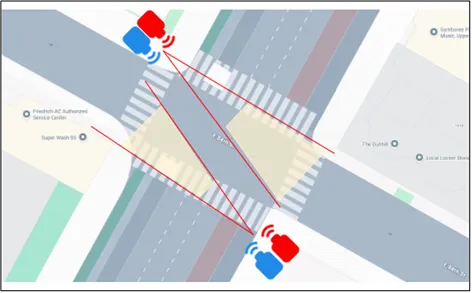
1. The detection of technical regulation violations (operation of vehicles without a valid inspection/authorization) requires the installation of video cameras with an enabled license plate recognition (LPR) function. These cameras may also be used to capture and recognize rear license plates of vehicles. An example of camera placement is shown in Figure 1.
Figure 1.
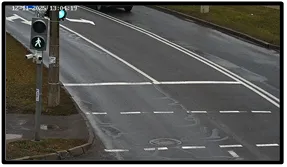
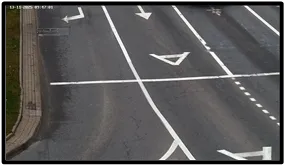
Examples of images obtained from LPR cameras are shown in Figure 2.
Figure 2.
 |  |
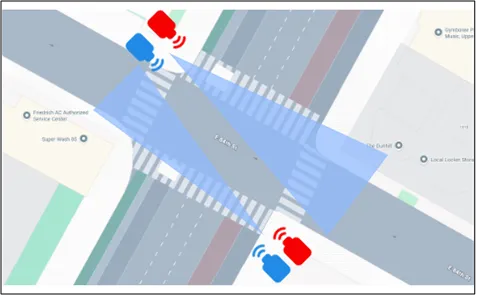
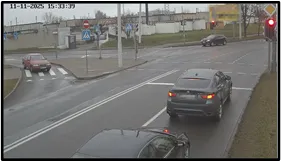
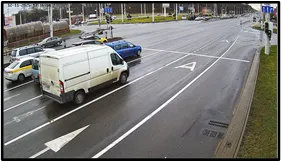
2. To build an evidentiary base and improve detection of secondary vehicle characteristics, including at night, overview video cameras (OV) must be used. An example of camera placement is shown in Figure 3.
Figure 3.
Examples of images obtained from OV cameras are shown in Figure 4.
Figure 4.
 |  |
3. To generate violation events, camera installation must comply with the requirements specified in Table 1.
Table 1
Preliminary Technical Requirements for OV Cameras | |
| Characteristic | Requirement |
| Tilt | from +15° to +75° |
| Pan | from –75° to +75° |
| Roll | from –5° to +5° |
| Image quality | 50 pixels/meter or higher |
| Illumination | 10 lx or higher |
| Mounting height | from 5 to 15 meters above the road surface |
Preliminary Technical Requirements for LPR Cameras | |
| Tilt angle relative to horizon (LPR) | from 10° to +30° |
| Tilt angle relative to vertical (LPR) | from –20° to +20° |
| Permissible roll (LPR) | from –5° to +5° |
| Image quality (LPR) | 300 pixels/meter or higher |
| Illumination (LPR) | 50 lx or higher |
| Mounting height (LPR) | from 6 meters or higher |