
Space Mean Speed above Limit
Definition
The “Space mean speed above limit” violations occurs if the car's space mean speed V calculated as ...
V=D/(T2 - T1)
... appears above the limit Vmax with account for a user-defined permissible tolerance ΔV, as the diagram below illustrates.
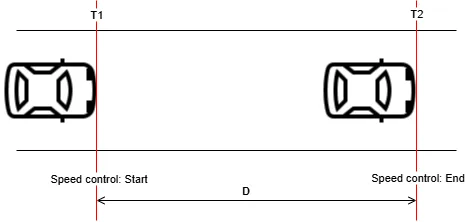
Here:
- D is assumed known.
- T1, T2 are the time stamps of the car's Focal point crossing the “Speed control: Start” and “Speed control: End” lines. They are reported as the attributes of the line crossing events detected by CarTrack Pro on the cameras watching these lines.
Steps to Set Up Space Mean Speed above Limit
- Build a road object, which might not be a crossroads for this violation type but a linear road segment (e.g. its name is “Broadway segment”). An already existing road object can also be used at steps 2 — 7.
- Bind cameras to the road object.
- Name the violation.
- Build the “Speed control: Start” and “Speed control: End” lines in CarTrack Pro settings on the camera meant to monitor these lines.
- Link the violation name (step 3) to the “Speed control: Start” and “Speed control: End” lines (step 4).
- Turn on speed control.
- Review the results.
Build the Speed Control Lines
Build the “Speed control: Start” and “Speed control: End” lines in CarTrack Pro settings on the camera meant to monitor these lines. Give these lines clear self-explanatory names, e.g., “Start line” and “End line”.
Link the Violation Name to the Speed Control Lines
Now let a violation of the “Illegal stop/ parking” type in the “No stop/ parking” area get its name. To do so:
- On the road object page, open the Options menu and select Violation rules. The screen shows:
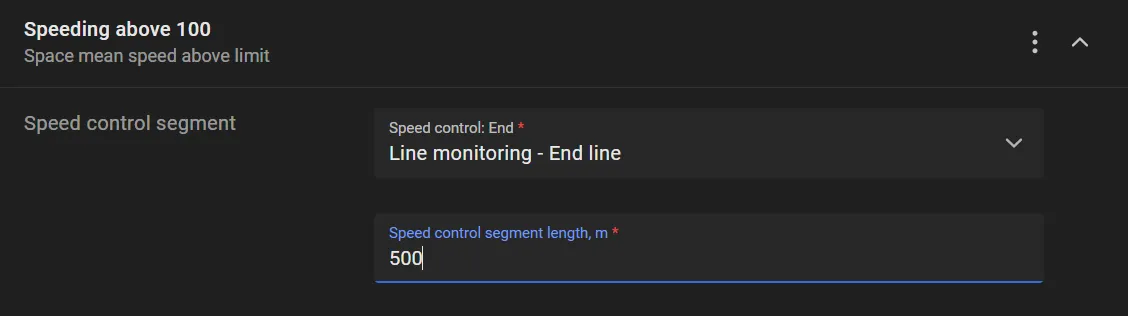
- In the Speed control segment, select the “Speed control: End” line labeled “End line” as shown.
- Enter the speed control segment length value, which we assume known.
- Enter the speed limit and tolerance value into the respective fields.
- Optionally, specify the cameras overviewing the speed control start and end.
- Click Save.
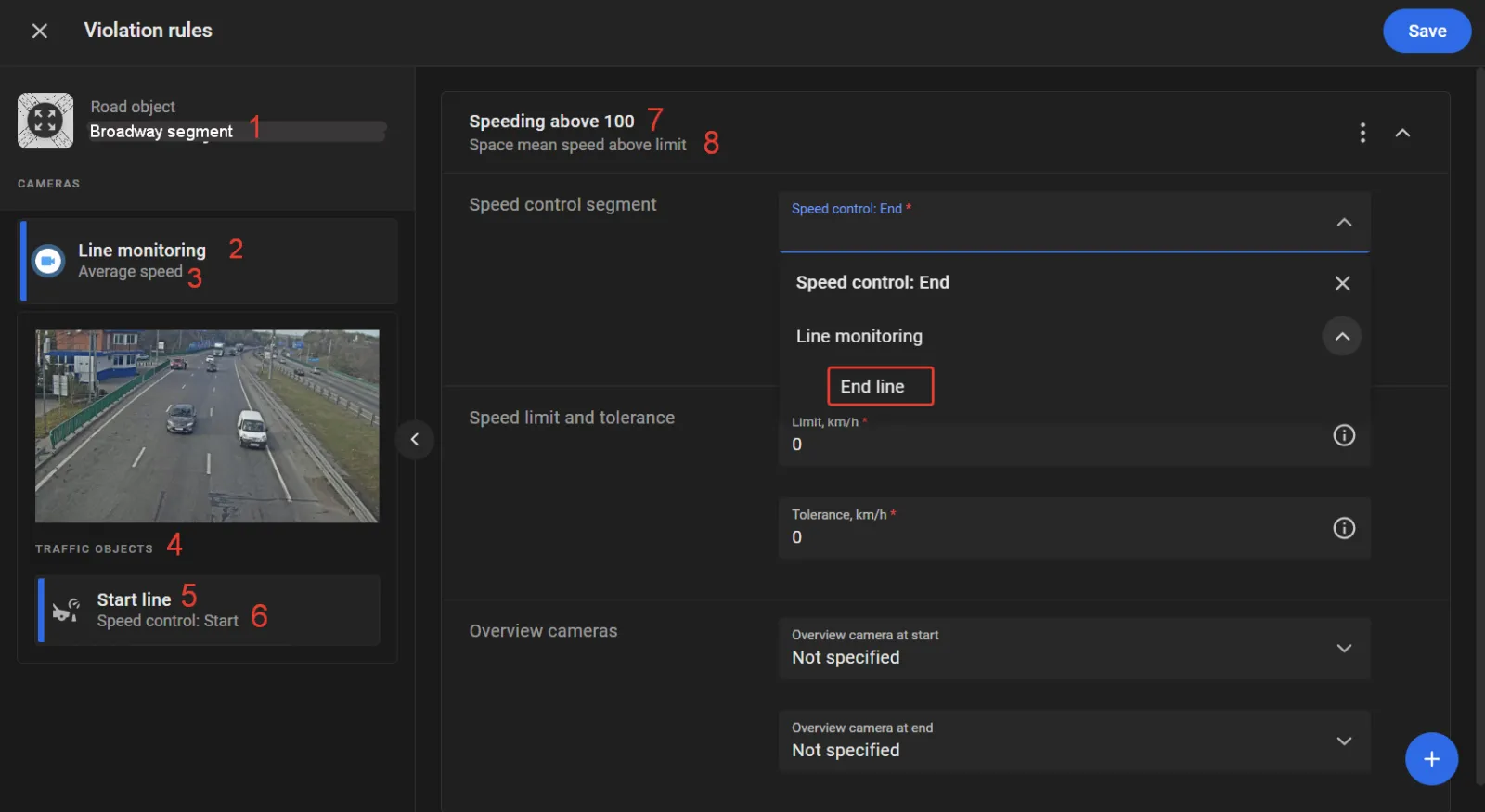
1 — the road object name given at step 2 in “Road objects”
2 — the camera label set in Bind cameras to the road object.
3 — the camera type set in Bind cameras to the road object.
4 — the list of traffic objects (their names and types) created on the camera needed to build a rule (the “Start line” in this case).
5 — traffic object name given at step 3 in “High speeding”.
6 — traffic object type defined at step 2 in “High speeding”.
7 — planned traffic violation name to be given at step 2 in this section below.
8 — traffic violation type.
Turn On Control
Control on a road object stays off until it is turned on. On the road object page, open the Options menu and select Turn on control. In the Turn on Road Object control window, select Space mean speed above limit and click Turn on.
With control on, the platform captures each violation and lists it on Find Traffic Rule Violations.