
General
How It Works
The tracking and recognition mode decides which networks the module runs. Each network is trained for one task.
Track vehicle
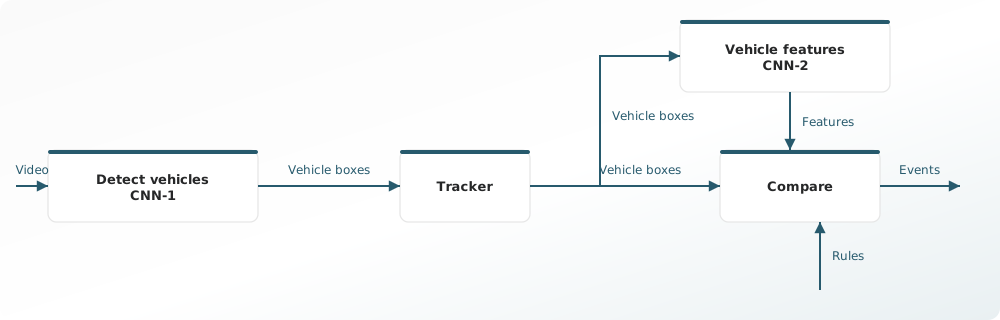
- CNN-1 finds vehicles in the incoming video and sends their boxes on.
- CNN-2 identifies features of the detected vehicles, such as color.
Recognize plate
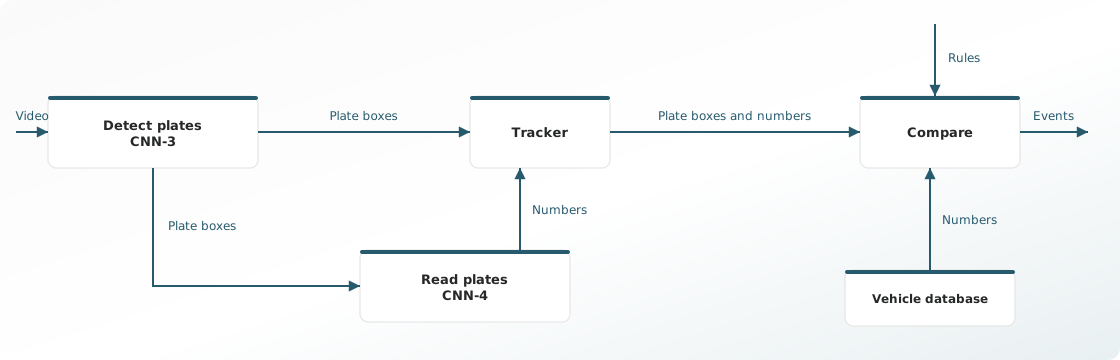
- CNN-3 finds license plates in the incoming vehicle video and sends them to CNN-4 to read the numbers.
- CNN-4 reads the numbers and sends them on for analysis.
Track vehicle and recognize plate
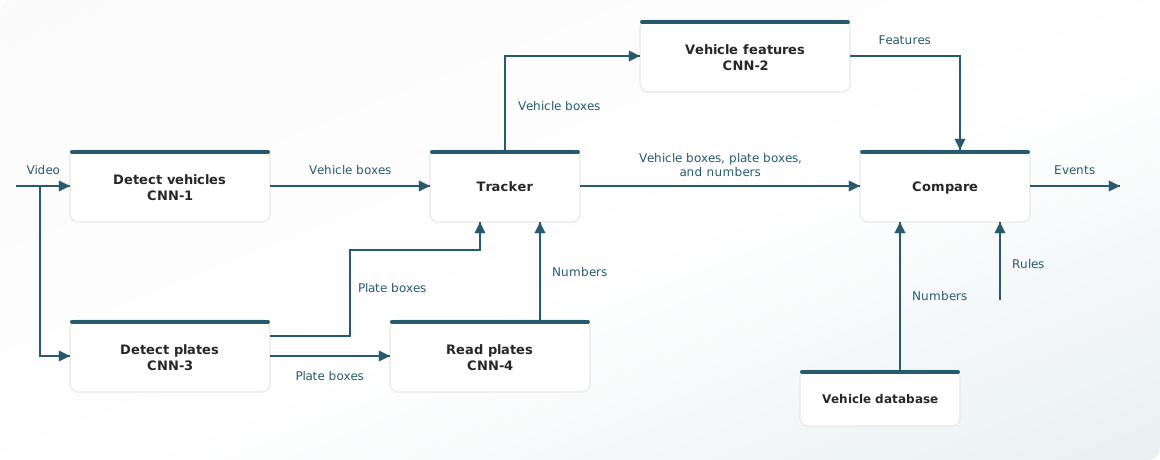
- CNN-1 finds vehicles in the incoming video and sends their boxes on.
- CNN-3 finds license plates in the incoming vehicle video and sends them to CNN-4 to read the numbers.
- CNN-2 identifies features of the detected vehicles, such as color.
- CNN-4 reads the numbers and sends them on for analysis.
Track vehicles with a recognized plate
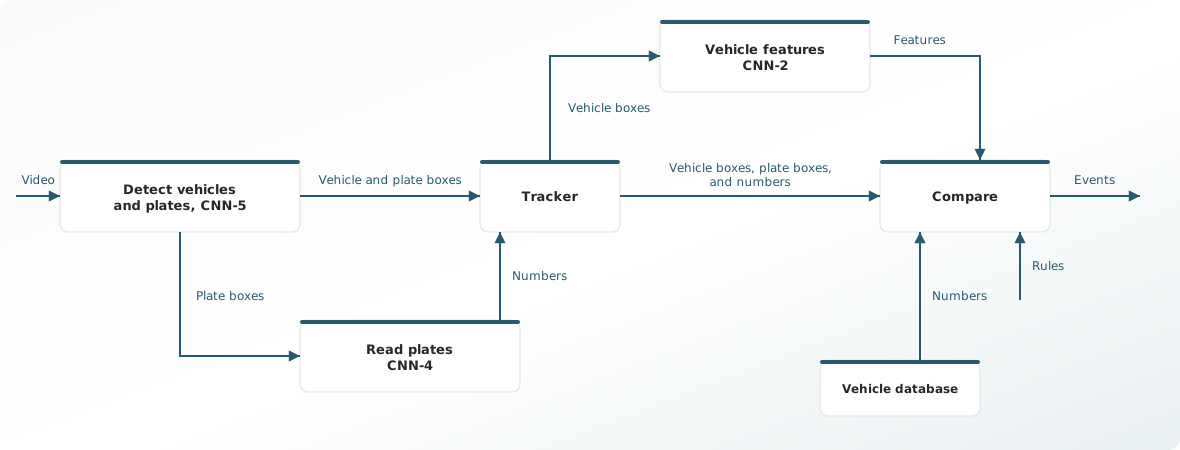
- CNN-5 finds vehicles and their license plates in the incoming video. The vehicle box and its plate box go on together as a pair.
- CNN-2 identifies features of the detected vehicles, such as color.
- CNN-4 reads the numbers and sends them on for analysis.
The last step compares the numbers that were read with the numbers in the vehicle database, checks other configured conditions, or does both. A vehicle in a restricted-entry zone is one such condition. From that result, the module decides whether to create an event. Vehicle type and color are determined when the event is created and are included in it immediately. The vehicle brand can be added later.
The selected mode also determines which settings are available:
| Track vehicle | Recognize plate | Track vehicle and recognize plate | Track vehicles with a recognized plate |
|---|---|---|---|
|
|
|
|
With Vehicle type and color recognition on, Track vehicle, Track vehicle and recognize plate, and Track vehicles with a recognized plate recognize these vehicle types:
| Type | Description |
|---|---|
| Motorcycle | Any powered two-wheeled or three-wheeled vehicle: a motorcycle, tricycle, scooter, or moped. |
| Car | A sedan, hatchback, station wagon, coupe, SUV, or crossover, with up to 8 seats. |
| Light-duty truck | A vehicle with a payload of up to 3.5 tons. |
| Medium-duty truck | A vehicle with a payload from 3.5 to 12 tons. |
| Heavy-duty truck | A vehicle with a payload over 12 tons. |
| Tractor-trailer | A tractor with a semitrailer, or a truck hitched to one or more trailers. |
| Minivan | Passenger vans and minibuses for up to 8 passengers, including minivans and MPVs (multi-purpose vehicles). |
| Bus | A vehicle for more than 8 passengers, including city buses, intercity buses, double-decker buses, and trolleybuses. |
| Machinery | Wheeled and tracked tractors for farm or municipal work, harvesters, and construction and road-building equipment: excavators, graders, pavers, cranes, and loaders. |
| Trailer | Any trailer or semitrailer standing apart from the tractor, for example in a parking lot, or a passenger-car trailer. |
Computational Complexity
The algorithm is rated 5 on a 5-point complexity scale. Average CPU usage is about 100%, and the load can vary with video resolution and the processor.
Camera Requirements
To select cameras, use specialized software (for example, IP Video System Design Tool) or a free lens calculator from the camera manufacturer.
| Characteristic | Requirement |
|---|---|
| CMOS sensor size | 1/2.8″ or larger |
| CMOS sensor light sensitivity | 0.005 lux or less for a color image with automatic gain control (AGC) on at 30 IRE; 0.0005 lux or less for a black-and-white image with AGC on at 30 IRE |
| Electronic shutter speed | adjustable from 1/25 to 1/10,000 second, or a wider range |
| Electronic shutter speed adjustment modes | automatic / adjustment range / manual |
| Number of video streams | 2 or more |
| Primary stream resolution | 1280×720 to 2560×1920 pixels |
| Secondary stream resolution (optional, for layouts) | 320×240 to 704×576 pixels |
| Video frame rate | 15 to 25 frames per second |
| Lens type | varifocal |
| Focus adjustment modes | automatic / semi-automatic / manual |
| Lens focal length | 4 mm or longer |
| Lens speed | f/1.6 or faster |
| Lens aperture | adjustable |
| Aperture adjustment modes | automatic / manual |
| Primary stream bitrate | up to 8 Mbps |
| Secondary stream bitrate | up to 1 Mbps |
| Video encoding type | constant (CBR) / variable (VBR) |
| Video encoding protocol | H.264 HP/MP/BP, H.265 |
| Network protocol support | TCP/IP, ICMP, HTTP, HTTPS, RTP, RTSP, NTP, SNMP, IGMP, IPv4/IPv6 |
| Video transmission protocol | RTP over TCP |
| ONVIF compatibility (optional, for remote camera control) | ONVIF (PROFILE S, PROFILE G) |
| Adjustable image parameters | saturation, brightness, contrast, sharpness, AGC, and switching between color and black-and-white |
| Image parameter adjustment modes | automatic / manual / scheduled |
| AGC adjustment modes | automatic / manual (the gain can be limited) |
| Image enhancement | digital noise reduction (DNR) and backlight compensation (BLC/HLC) |
| Noise reduction adjustment | automatic / manual (noise reduction levels can be adjusted) |
| Backlight compensation adjustment | automatic / manual (a target zone for backlight compensation can be set) |
| Built-in illumination | 50 meters or more |
| Illumination modes | automatic / intelligent / manual (range and intensity can be adjusted) |
Camera Mount Requirements
| Characteristic | Requirement |
|---|---|
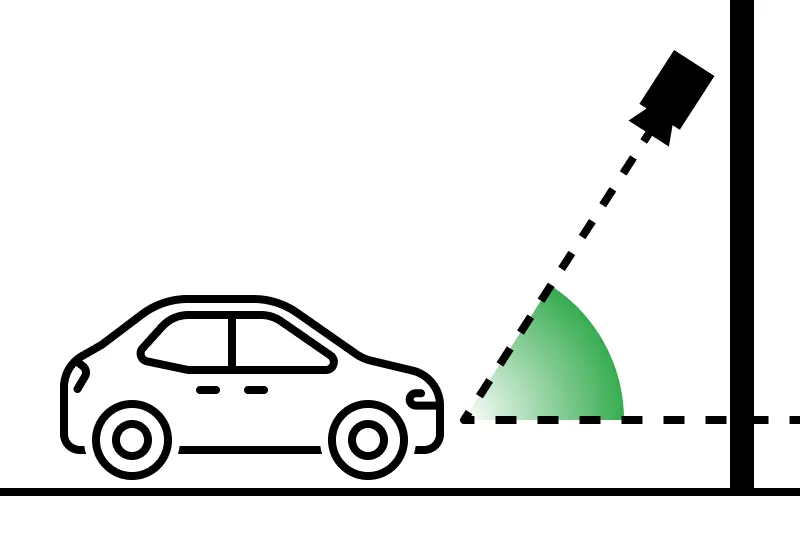
Camera tilt relative to the horizon
|
0° to +20° |
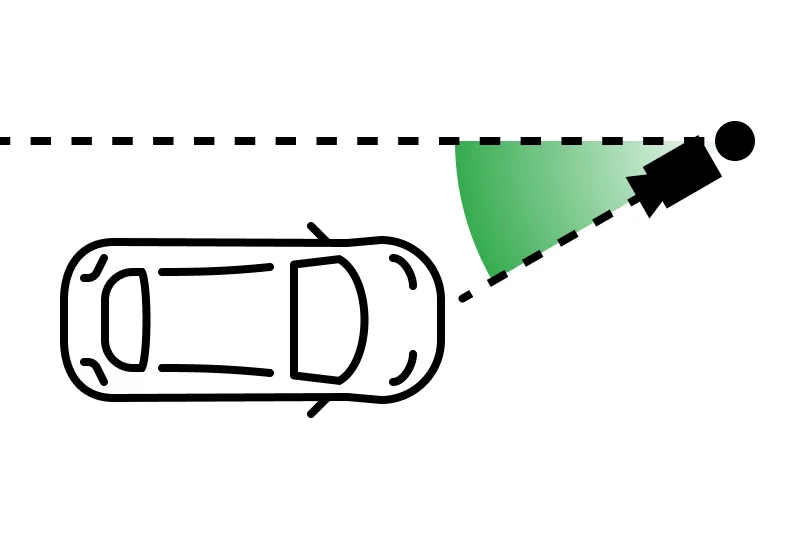
Camera angle relative to the road direction
|
−20° to +20° |
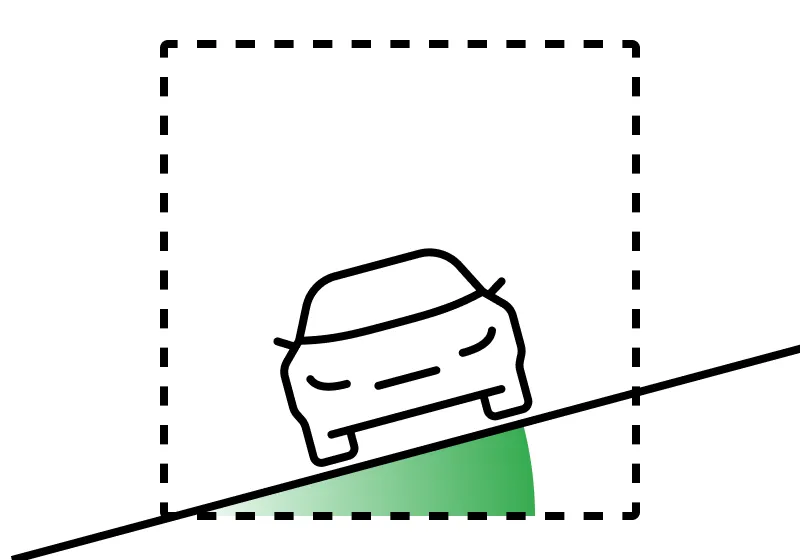
Camera roll about its axis
|
−5° to +5° |
| Image quality at the border of the controlled zone | 250 pixels per meter or more |
| Recommended mounting height in parking lots and parking garages | 0.5 to 2 meters above ground level |
| Recommended mounting height on roads, highways, and intersections | 3 to 8 meters above ground level |
| Illumination of the controlled zone | 50 lux or more across the camera scene. The vehicle in view must be lit evenly. |